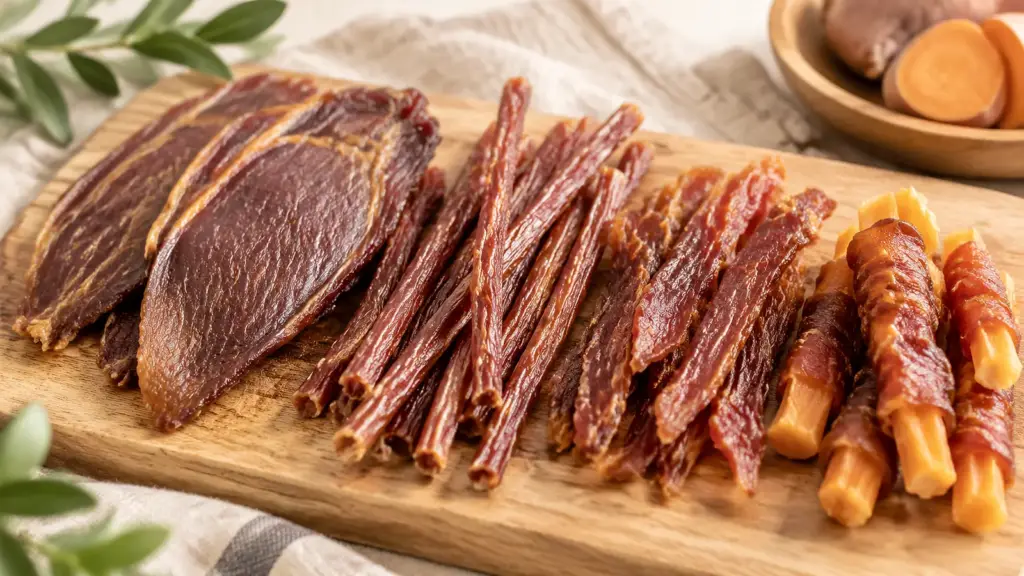
Buying duck dog treats wholesale comes down to three decisions: which formats fit your range (whole fillets, sticks, tenders, slices, wrapped treats or biscuits), which spec limits you write into the contract (protein, fat, moisture, water activity, pathogen testing), and which factory is actually certified to make them. This guide walks through each decision with real guaranteed-analysis figures from a working duck line, so you can compare quotes on numbers rather than photos.
Key takeaways
- Pure air-dried duck breast typically lands around 42–44% crude protein with moisture capped at 20%; wrapped formats drop to about 30% protein because the core dilutes the meat.
- Duck is a useful single-protein option for ranges built around chicken and beef, but “hypoallergenic” and other medical claims do not belong on a treat label.
- Write moisture, water activity, Salmonella testing and metal detection into your spec sheet. Asking only for “premium quality” gets you nothing you can enforce.
- Check the scope of a supplier’s food-safety certificate. A certificate that covers dried duck breast pet food is stronger evidence than a general company certificate.
- Expect an 18-month shelf life in nitrogen-flushed, resealable packs, and ask for a mixed sample box before you commit to a first order.
Why Duck Is a Growing Protein in Treat Ranges
Most dog treat shelves are still built on chicken, beef and pork. Duck gives a brand a way to widen the range without reinventing its production model. Duck breast is lean, dries into a dark, glossy strip that looks like real meat, and reads as “premium” to shoppers who have already tried every chicken jerky on the shelf.
For buyers, three arguments usually decide it:
- Single-protein ranges. Many owners run elimination trials or simply want to know exactly what their dog is eating. A treat made from duck breast plus a humectant is easy to explain on the pack and fits into a single-protein or limited-ingredient line.
- Rotation and differentiation. Retailers want a second and third protein beside chicken. Duck carries a higher shelf price than chicken, and most shoppers accept that.
- Format flexibility. Duck breast slices thin and wraps well, which is why it dominates the wrapped-treat category (sweet potato, rawhide, trachea, fruit).
Be careful with claims, though. Duck is sometimes marketed as a “novel protein”, but it now appears in plenty of commercial diets, so it is not novel for every dog. Words like “hypoallergenic” or “for dogs with allergies” can be read as disease claims. Keep the pack factual (“single animal protein: duck”), and let owners and vets decide how to use it. Our guide to dog treat label requirements covers where the claim lines sit.
Duck Treat Formats
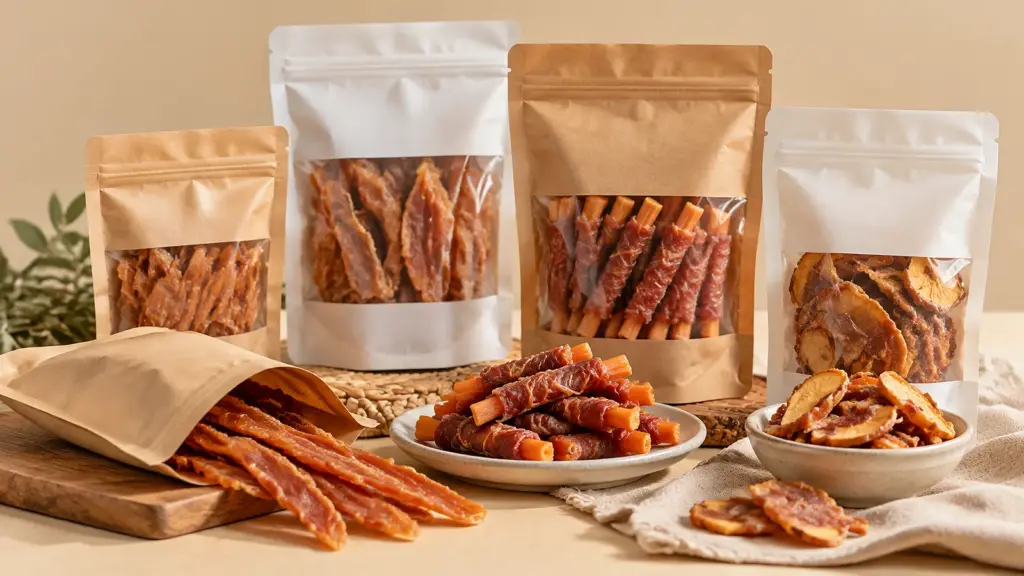
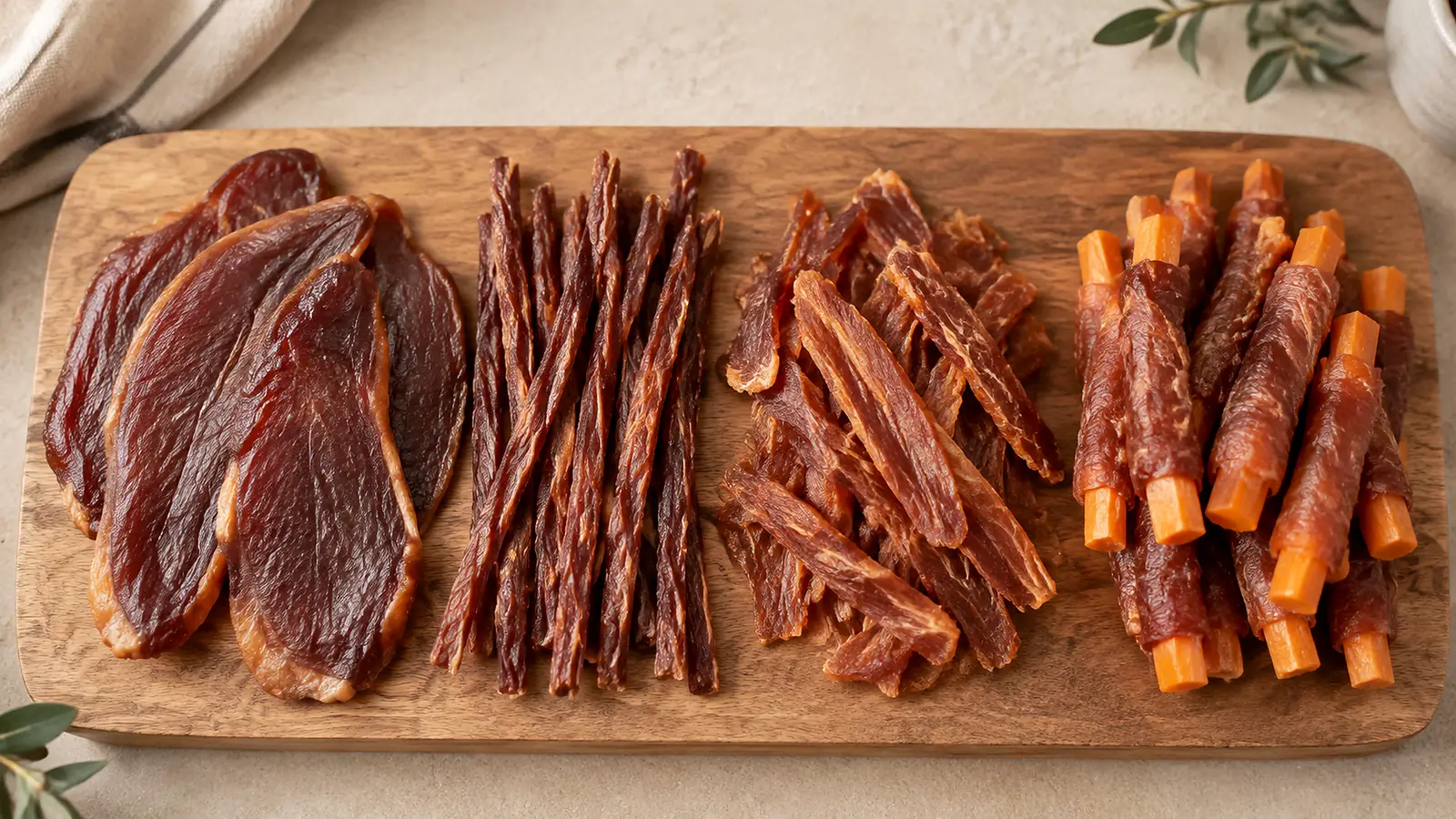
A complete duck range usually has four families. Each one differs in how much meat it uses, how much labor it takes, and what it can sell for.
Whole fillets and tenders
This is the benchmark SKU. A whole duck breast or tenderloin is thawed, trimmed, sliced if needed, and dried in one piece. Because nothing is ground or pressed back together, the grain of the meat stays visible, and buyers use that as a quick authenticity check. Our Whole Duck Fillet is 97% duck breast. The rest is food-grade glycerin and a trace of sorbitol, which keep the strip pliable. Raw-Cut Duck Tenders use tenderloin instead of breast and have a slightly softer bite.
Fillets cost the most to make, because yield depends on how well the breast is trimmed, and every piece that breaks during drying is lost from the premium grade.
Sticks, slices and rolls
Cutting the breast into long strips gives you Duck Sticks, which break easily for training and suit small dogs. Thin slices can be co-dried with a botanical such as endive (see Endive Duck Breast Slices) to add a story without losing the single-protein position. Rolls are layered or formed: Duck Snowflake Rolls layer duck with cod, and Chicken & Duck Hollow Rolls blend the two poultry proteins into a hollow tube that takes longer to chew. Rolls give you consistent shapes, but they add ingredients. Snowflake rolls contain soy and peanut protein, for example, so they are not single-protein SKUs.
Duck-wrapped treats
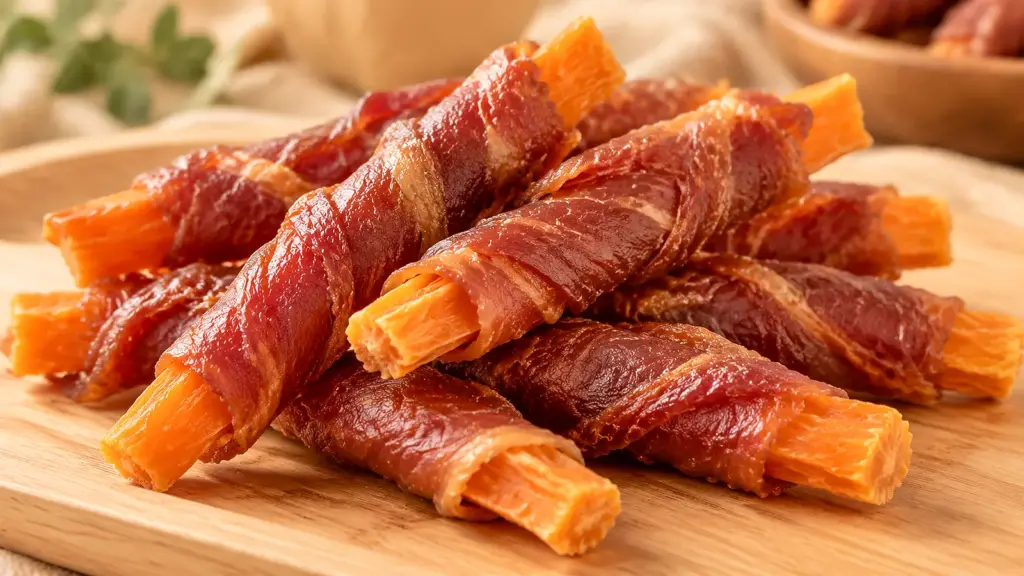
Here a slice of duck breast is wound by hand around a core: sweet potato, pumpkin, kabocha, dried apple, okra, egg yolk, beef rawhide or duck trachea. Wrapped treats look great in a window bag, and each one tells a meat-plus-veg or meat-plus-chew story. Labor is the main cost driver. We cover the category in depth in Wrapped Dog Treats Explained.
Biscuits and donuts
Biscuits and donuts use duck as the dominant ingredient but mix in something else. Duck & Corn Biscuits press duck breast with sweet corn kernels. Duck Donuts wrap duck around a sweet-potato ring. Parsley Crunch Balls puff duck, egg yolk and potato flour into a light, low-moisture bite (≤13%) that suits small breeds. These formats usually cost less per kilo and help you fill the lower price tiers of a range.
Spec Sheet: What to Check
Here is how the formats compare on paper. All figures come from the guaranteed analysis and ingredient declarations of real SAGEIC duck SKUs. Protein is a minimum, moisture is a maximum, and fat is stated as a minimum, as on the label.
| Product | Format | Duck content | Crude protein (min) | Crude fat (min) | Moisture (max) |
|---|---|---|---|---|---|
| Whole Duck Fillet | Whole fillet | 97% duck breast | 44.0% | 2.8% | 20.0% |
| Raw-Cut Duck Tenders | Tender | 97% duck tenderloin | 44.0% | 2.6% | 20.0% |
| Duck Sticks | Stick | 97% duck breast | 43.0% | 2.6% | 20.0% |
| Endive Duck Breast Slices | Slice | 93% duck breast | 42.0% | 2.8% | 20.0% |
| Duck Snowflake Rolls | Layered roll | 75% duck + 13% cod | 40.0% | 2.5% | 22.0% |
| Duck-Wrapped Trachea | Wrapped chew | 55% breast + 42% trachea | 45.0% | 3.2% | 21.0% |
| Duck-Wrapped Rawhide Sticks | Wrapped chew | 56% duck + 41% beef hide | 57.0% | 3.0% | 21.0% |
| Duck-Wrapped Sweet Potato Sticks | Wrapped veg | 61% duck + 36% sweet potato | 30.0% | 3.0% | 22.0% |
| Duck & Corn Biscuits | Biscuit | 65% duck + 32% corn | 33.0% | 3.0% | 22.0% |
| Parsley Crunch Balls | Puffed ball | 60% duck + egg yolk, potato flour | 35.0% | 7.0% | 13.0% |
Three patterns stand out:
- Pure duck sits at 42–44% protein and about 2.6–2.8% fat. If a supplier quotes a “100% duck breast jerky” at much lower protein, ask why. Higher moisture or added starch are the usual reasons.
- The core sets the numbers in a wrapped treat. Sweet potato and other plant cores pull protein down to about 30% and push fiber up to around 9–10%. Rawhide cores push protein up to 57–58%, because dried hide is mostly collagen.
- Humectants are normal. Hiding them is not. Soft-dried duck usually carries 2–3% food-grade glycerin, sometimes with a little sorbitol, to stay pliable at a safe moisture level. They must appear in the ingredient list. Decide early whether your brand accepts them, because a glycerin-free spec means a harder, drier product.
What to put in your spec sheet
A good duck treat spec is a one-page document both sides sign. At minimum it should cover:
- Guaranteed analysis: protein minimum, fat minimum/maximum, fiber, ash and moisture maximum, matching what will be printed on the pack.
- Water activity (aw): moisture alone does not tell you how stable the product is. Water activity measures how much of that water is available to microbes. Many buyers set a maximum well below 0.85 to leave headroom against mold. Agree on the figure and the test method with your supplier.
- Microbiology: Salmonella must be negative. In the US, FDA treats Salmonella-contaminated pet food as adulterated (see CPG Sec. 690.800). Ask for per-lot results and state sample size and lab accreditation. Add total plate count, Enterobacteriaceae, and yeast and mold limits if your market expects them.
- Foreign-body control: metal detection on every pack (state Fe/non-Fe/stainless test piece sizes), plus a visual inspection step for bone, feather and plastic.
- Physical specs: length, width and thickness tolerances, pieces per kilo, color range (a photo standard helps), and the maximum percentage of broken pieces.
- Residues and origin: where the duck comes from, and which antibiotic or veterinary drug residue tests you expect and how often. Ask for these in writing. Don’t assume them.
- Shelf life and storage: best-before period, storage conditions, and how many days the product stays good after the pack is opened.
Air-Dried vs Baked Duck Treats
Most duck jerky sold as a treat is dried at low temperature over many hours, not roasted. Suppliers use “air-dried”, “low-temperature dried” and “slow-baked” for overlapping processes. What matters is the time and temperature profile and the final moisture.
| Low-temperature air-dried | Oven-baked / higher heat | |
|---|---|---|
| Texture | Pliable, chewy, tears by hand | Firmer to crunchy |
| Typical moisture | About 18–22%, usually needs a humectant | Lower, often under 15% |
| Appearance | Dark red-brown, visible muscle grain | Darker, more uniform surface |
| Best for | Fillets, sticks, wrapped treats | Biscuits, crunchy bites, puffed balls |
| Main risk to control | Water activity and mold over shelf life | Over-drying, breakage, dust in pack |
Neither process is “better”. The question is which texture your customer wants, and whether the validated kill step and final water activity can be shown on paper. When you compare suppliers, ask for the drying profile (temperature, time, airflow) and how they verify it batch by batch.
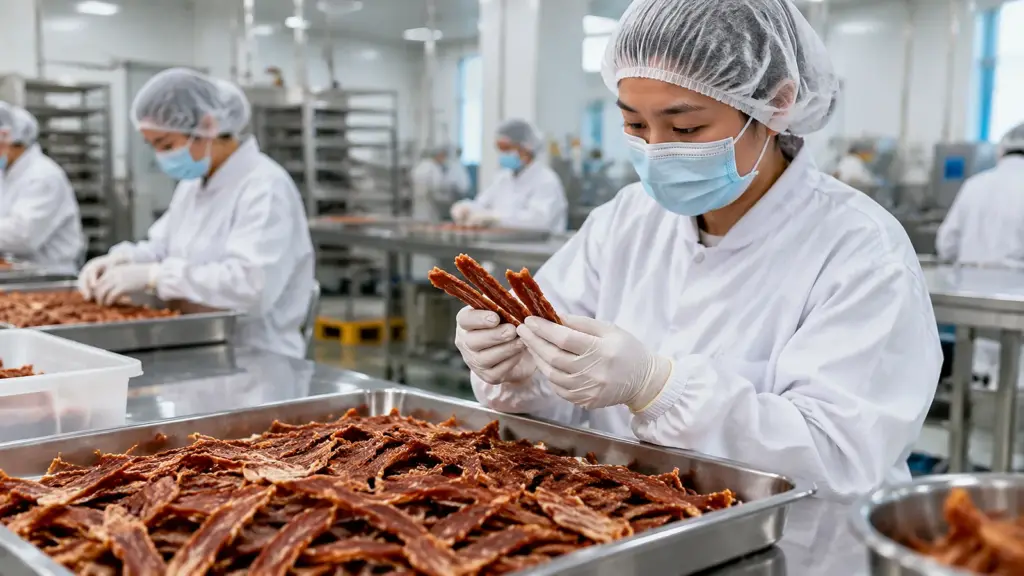
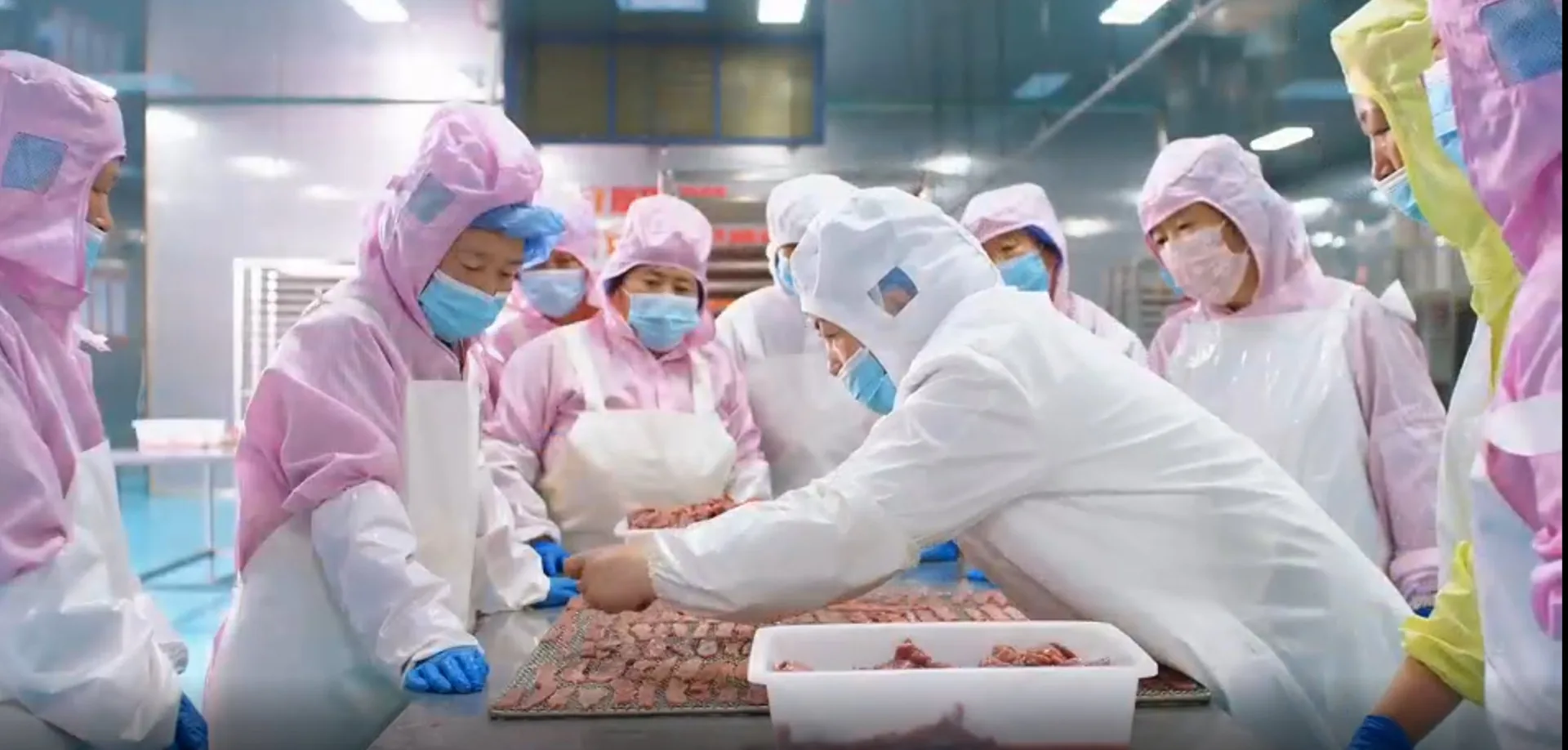
At our Qingdao plant, fresh duck moves from source to production within three days and is then thawed, sliced and dried at low temperature. Moisture, protein, fat and microbiology are checked in our in-house lab, and third-party testing (SGS or Intertek) is available if your market or retailer requires it.
Sourcing Duck Treats: Certification Scope Matters
Almost every exporter will send you a stack of certificates. What matters is what each certificate actually covers.
- Read the scope line. A GFSI-benchmarked certificate such as BRCGS lists the products and processes that were audited. If the scope says “pet food”, that is not the same as “dried duck breast pet food, sliced and dried on site”.
- Verify it independently. BRCGS certificates can be checked in the public BRCGS Directory. Check the site name, grade, expiry date and scope.
- Match it to the destination. Food-safety certification does not replace import eligibility. The US, EU, Japan and Korea each have their own rules for poultry-based pet treats, and the EU in particular restricts which third-country establishments can ship heat-treated poultry products. See importing dog treats into the US, and always confirm current requirements with the official authority.
SAGEIC holds BRCGS Food Safety Issue 9 (Grade B, certificate 0244974, issued by Intertek under UKAS accreditation 014, valid to 11 May 2027). Its scope is the thawing, slicing, drying and selecting of duck breast pet food, packed in PE/PET bags. In other words, it covers the core duck breast products in this guide, such as fillets, sticks, tenders and slices. We also hold ISO 9001, ISO 22000 and HACCP, and are registered with China Customs for export.
If you are still assessing Chinese suppliers in general, How to Choose a Dog Treat Manufacturer in China gives you a full audit checklist, and Are Dog Treats Made in China Safe? covers the history buyers still ask about.

Building a Duck Range by Price Tier
A practical duck range usually has three tiers rather than one hero SKU:
- Premium tier (single protein). Whole fillets, tenders and sticks. These are 97% duck with the highest protein figures and the cleanest ingredient list. They anchor the brand and carry the highest shelf price.
- Core tier (wrapped). Sweet potato, pumpkin and apple wraps, with trachea or rawhide wraps for longer chews. Replacing part of the meat with a core lowers cost per kilo. The visual variety fills a shelf bay or an online listing page.
- Value and training tier. Biscuits, donuts and crunch balls. These are smaller pieces used more often during the day, and suit multi-packs and subscription add-ons.
The main cost drivers are meat content, hand labor (wrapping and trimming), yield loss during drying, and packaging format. When comparing quotes, normalize them to the same meat percentage, piece size and pack spec. Otherwise you are comparing different products.
Packaging and Shelf Life
Air-dried duck is shelf-stable, but the pack does a lot of the work. Common formats are stand-up pouches, zip-lock bags, PET jars, display boxes and bulk cartons for repackers. For soft-dried meat, most brands choose nitrogen flushing plus an oxygen absorber to hold color and slow fat oxidation. With that setup, 18 months unopened in cool, dry storage is a realistic best-before. After opening, the product should be used within about 30–40 days depending on format. Wrapped rawhide keeps longer after opening than pure meat.
Before launch, run your own check: keep retained samples at room temperature and under warm, humid conditions, and test appearance, smell, moisture and mold at intervals. That gives you data if a customer complaint comes in at month 14.
Duck Dog Treats Wholesale: Sourcing Checklist
- Define the range: which formats, sizes and price tiers. Decide whether you need single-protein SKUs.
- Request spec sheets with guaranteed analysis and full ingredient percentages for each SKU.
- Agree on moisture, water activity, micro limits, Salmonella testing per lot, and metal detection settings.
- Verify the certificate scope and expiry in the public directory, and check destination-market eligibility.
- Order a mixed sample box, then test texture, color, smell and dog acceptance. Send samples to your own lab if possible.
- Confirm packaging, nitrogen flush, shelf life, and label artwork review against your market’s rules.
- Lock MOQ, lead time, Incoterms and payment terms. For a private label duck range, MOQ typically starts at about 500 kg per SKU (negotiable). Sampling takes 2–3 weeks, and production 30–45 days after artwork approval. See private label MOQ and cost for budgeting.
The full launch process, from brief to first container, is in our private label dog treats guide, and how we run projects is on the OEM/ODM page. You can browse the full duck series on our products page.
FAQ
What protein level should I expect from pure duck jerky dog treats?
Low-temperature dried duck breast with about 20% maximum moisture typically guarantees around 42–44% crude protein and roughly 2.5–3% crude fat. Wrapped treats with vegetable or fruit cores are closer to 30% protein. Rawhide-core wraps go above 55%.
Are duck treats good for dogs with allergies?
Duck is a common choice for owners who want to avoid chicken or beef, and a single-protein duck treat makes that easy. However, “for dogs with allergies” or “hypoallergenic” on a label can be treated as a medical claim. Describe the ingredients plainly and let vets advise individual dogs.
Why do soft duck treats contain glycerin?
Food-grade glycerin (usually 2–3%) is a humectant. It keeps the meat pliable while holding water activity low enough for shelf stability. Without it, the product must be dried harder and becomes brittle. It has to be declared on the ingredient list.
What shelf life do wholesale duck treats have?
In sealed, nitrogen-flushed packs stored cool and dry, 18 months is standard. After opening, use within about 30–40 days depending on the format.
What is the minimum order for private label duck treats?
At SAGEIC the typical starting point is about 500 kg per SKU, and this is negotiable. Samples take 2–3 weeks, and mass production 30–45 days after artwork approval.
Get our duck range spec sheets
Tell us your market, formats and target price tier. We’ll send spec sheets for our duck series, with guaranteed analysis and ingredient percentages, plus a mixed sample box so you can compare fillets, sticks and wrapped treats side by side.