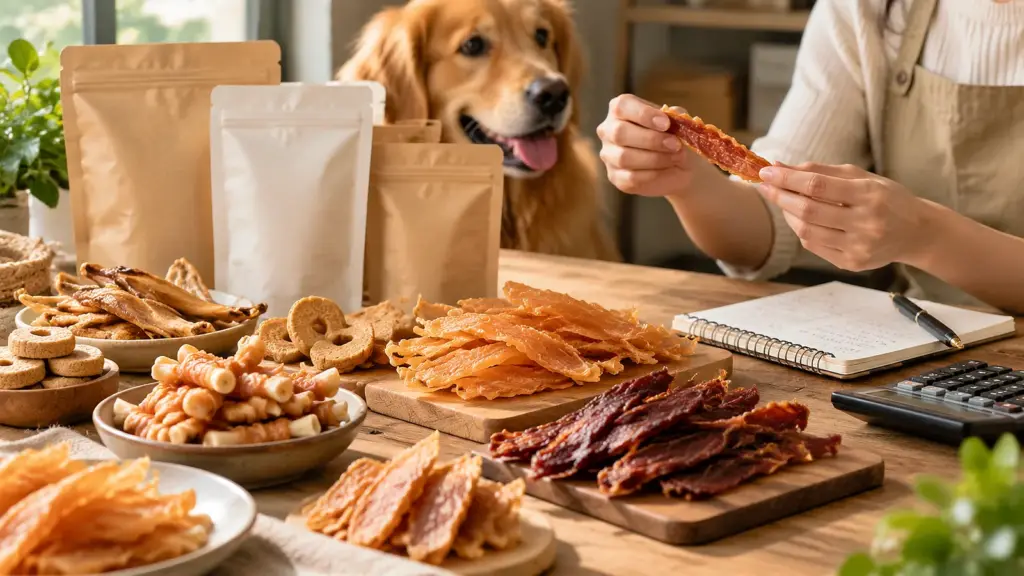
Private label dog treat MOQs are usually set per SKU by weight; at SAGEIC the typical minimum is from 500 kg per SKU, negotiable by format and packaging. Your first-order budget is driven by five things: raw meat, format complexity, packaging, testing and documents, and freight plus duties. This article explains each cost driver and shows how to structure a budget for a three-SKU launch before you ask for quotes.
Key takeaways
- MOQs for dried dog treats are normally quoted in kilograms per SKU, because each recipe needs its own raw material purchase, line setup and packaging run.
- Raw meat is usually the largest line in the unit cost; wrapping and shaping add labor on top.
- Printed packaging often has its own minimum, which can matter more than the product MOQ.
- Compare suppliers on landed cost per kg (product + packaging + testing + freight + duties), not on the ex-works price alone.
- Starting with one or two hero SKUs and a stock-size pouch is the simplest way to lower first-order risk.
Typical MOQs in Pet Treat Manufacturing
Dog treat manufacturers set minimums to cover the fixed work that every production run needs, regardless of size: buying and thawing a batch of fresh meat, setting slicing thickness and drying profiles, cleaning down between recipes, running QC on the lot and packing. Below a certain run size, those fixed costs dominate the unit price.
That is why MOQs for dried treats are almost always quoted per SKU, by weight rather than per order or per bag. A “SKU” here generally means one recipe in one pack configuration. Two pack sizes of the same recipe may share one production run but still need two packaging runs, so ask how your supplier counts them.
Why MOQs vary between suppliers
| Supplier type | Typical MOQ approach | What it means for you |
|---|---|---|
| Small workshop or co-packer | Low minimums, often by bag count | Easy to start, but capacity, certifications and consistency at scale can be limited |
| Trading company | Varies; depends on the factory behind it | Check which plant actually produces and whose certificates apply |
| Export-focused factory | Per SKU by weight, hundreds of kg upward | Higher entry point, but documented QC, batch traceability and export experience |
| Large-volume plant | Per SKU, often tonnes | Best unit cost at scale; hard to access for a first launch |
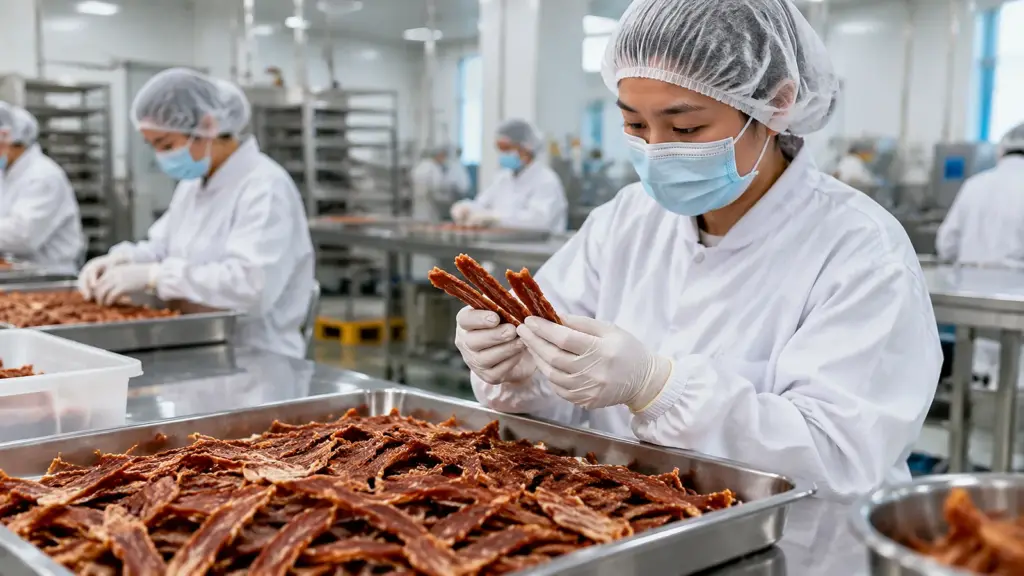
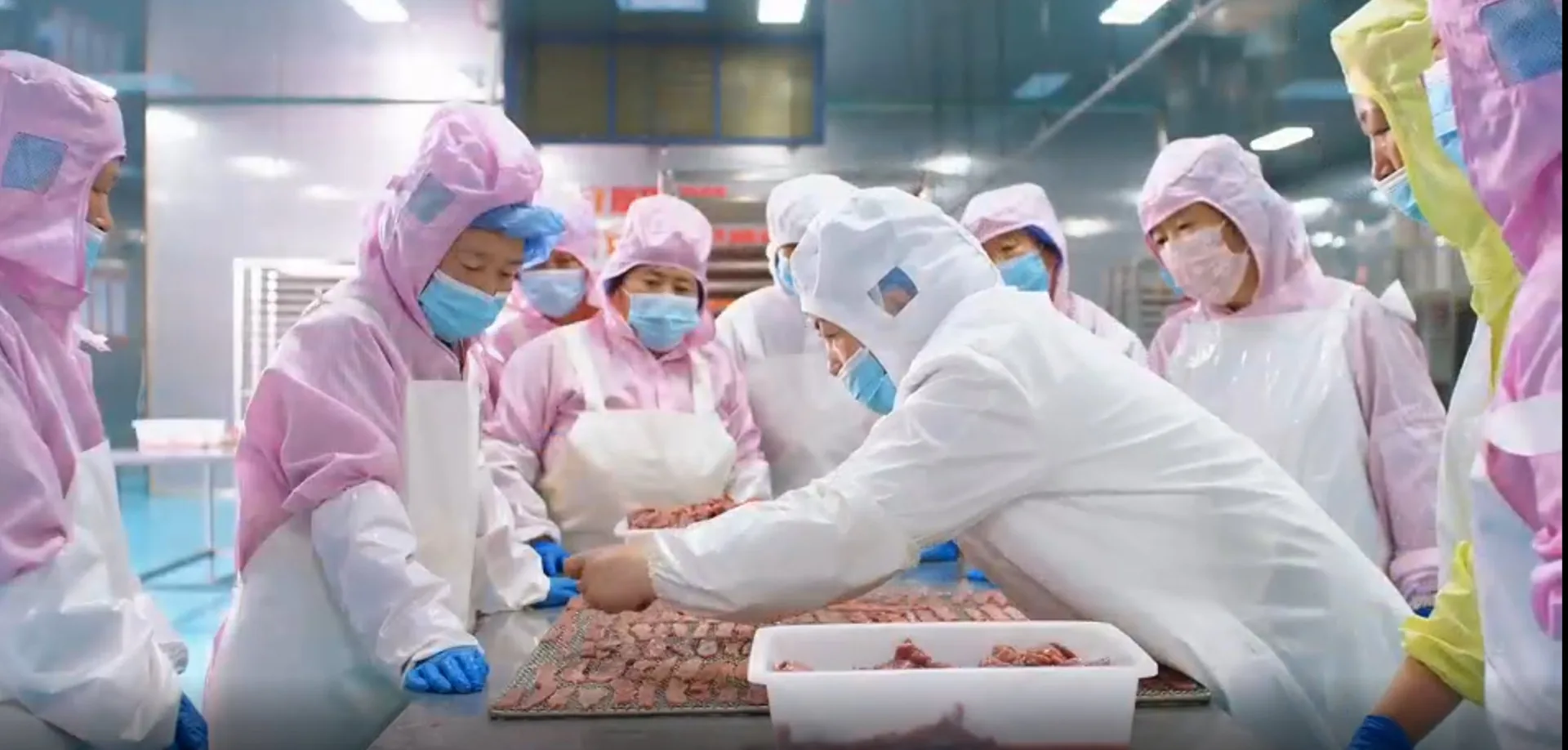
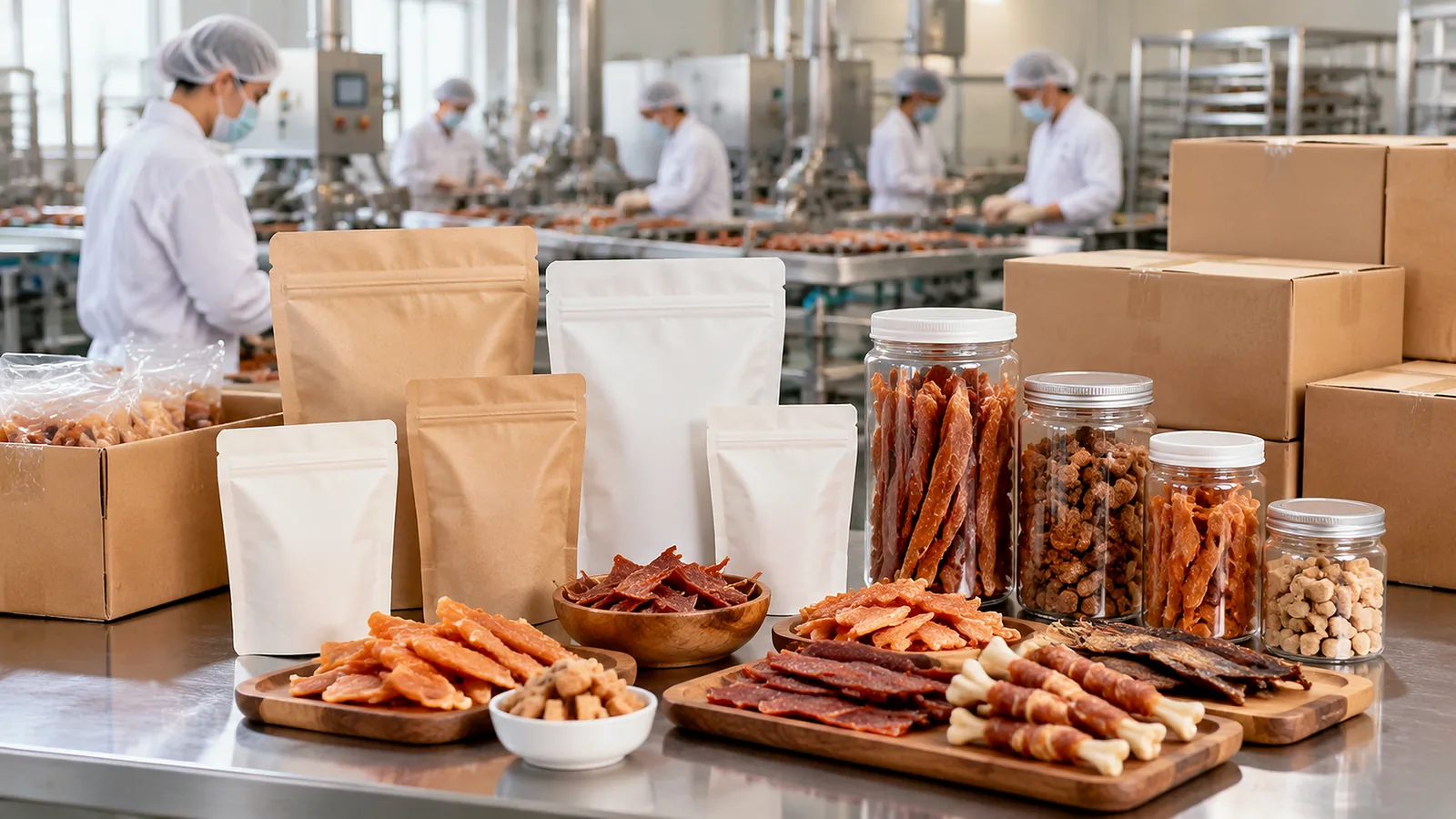
At our Qingdao plant, the private label MOQ is typically from 500 kg per SKU, and we discuss it case by case depending on format and packaging. With 2,000+ tonnes of annual capacity, the MOQ is about run efficiency, not about squeezing small buyers out: once a SKU sells, reorders can scale without changing supplier.
Don’t forget the packaging MOQ
Printed pouches and films are made by packaging converters with their own minimums, which are often set by print run length rather than by weight of treats. If your product MOQ is 500 kg but you choose a small bag size, the number of printed pouches needed can be high, and the film minimum may exceed what one product run uses. Ask your supplier for both numbers before you lock pack size.
What Drives the Unit Cost of Private Label Dog Treats
Quotes for private label pet treats are built from the same cost blocks everywhere. Knowing them helps you read a quote, compare suppliers fairly and see where you have room to trade off.
Raw protein: duck vs chicken vs rabbit
For meat-based treats, raw meat is usually the largest single cost line. Two factors matter:
- Protein price. Chicken breast is generally the most widely available and price-stable protein. Duck, rabbit, fish, beef and lamb tend to sit higher and can swing more with seasonal supply.
- Drying yield. Drying removes most of the water in fresh meat, so each kilogram of finished jerky needs several kilograms of raw meat. A higher meat share or a lower target moisture raises the raw-material cost per finished kilogram.
Recipes that combine meat with vegetables, fruit or biscuit (for example sweet potato, pumpkin or goat milk biscuit) can lower the meat share per kilogram while adding shelf appeal.
Process: air-dried, baked, wrapped
Process choices change labor, line time and yield:
- Slices and fillets are the most straightforward: cut, lay out, dry.
- Baked biscuits and shaped rolls add forming steps but can run efficiently at scale.
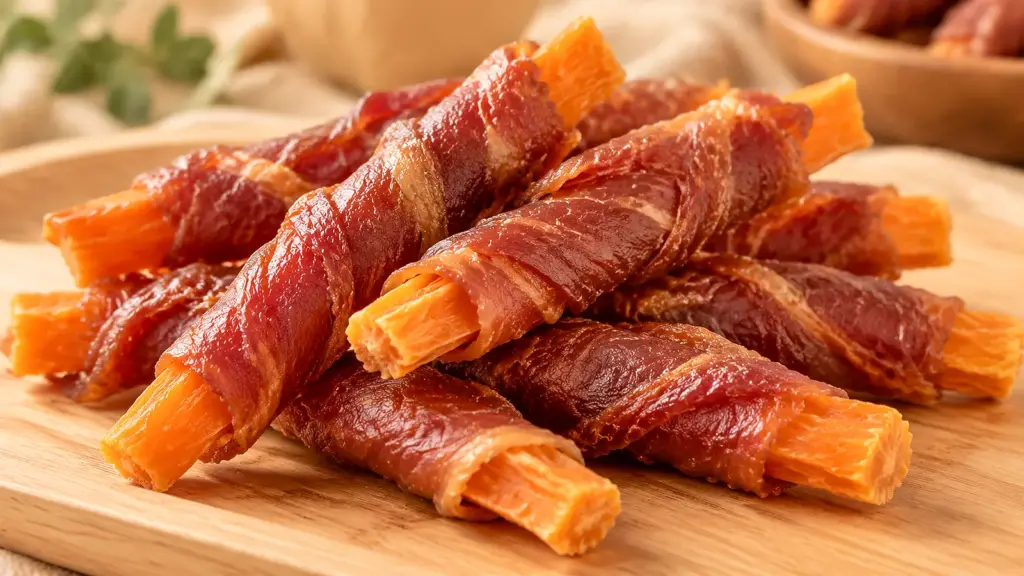
- Wrapped treats (meat hand-wrapped around a core) are the most labor-intensive and usually carry a premium over a plain jerky of the same protein. See our wrapped dog treats buyer’s guide for format details.
- Tight specs on piece size, thickness or color uniformity increase sorting and rejection rates.
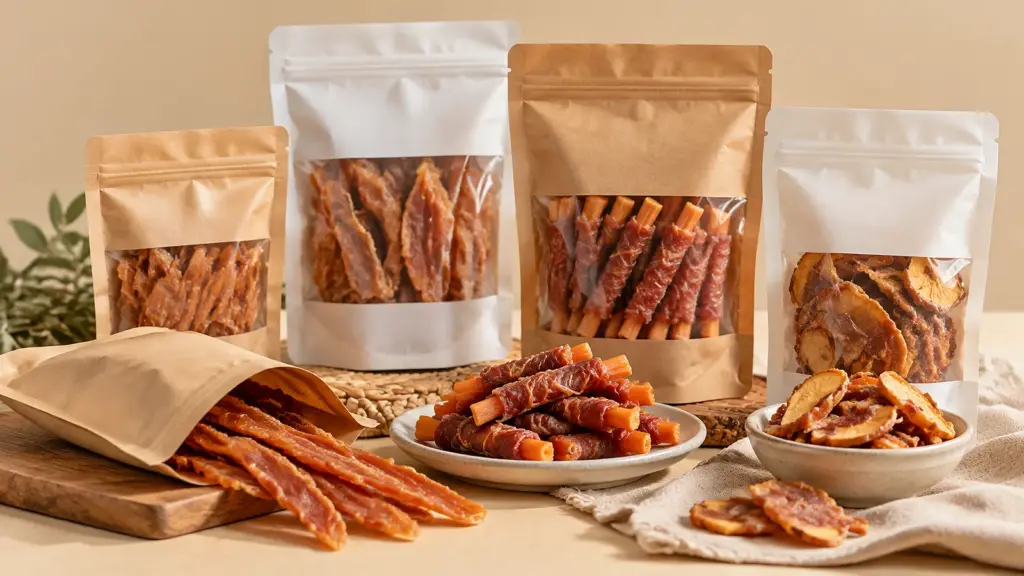
Packaging: stock bag vs printed pouch vs retail box
| Packaging option | Relative cost per kg | Setup and minimums | Best for |
|---|---|---|---|
| Bulk carton with inner PE bag | Lowest | None beyond the carton | Repackers and distributors who pack locally |
| Stock pouch with printed label or sticker | Low to medium | Label print run only | Test launches and e-commerce trials |
| Custom-printed stand-up zipper pouch | Medium | Printing plates or digital setup; film minimum | Most retail private label programs |
| PET jar or display box | Highest | Tooling or print setup, more cartons per kg | Pet specialty shelves, gifting, checkout |
Nitrogen flushing with an oxygen absorber adds a small cost per bag and helps protect flavor, color and fat stability over an 18-month shelf life. Smaller pack sizes raise packaging cost per kilogram of product, because you pay for more bags, zippers and cartons per kilo.
Testing, certificates and export documents
Every shipment carries some fixed document and testing cost. Our in-house lab covers moisture, protein, fat and microbiology; third-party reports from labs such as SGS or Intertek can be added on request, and each report has its own fee. Destination markets may also require health certificates, permits or registrations on the importer’s side. For the US, see our guide to importing dog treats: FDA, FSVP and APHIS, and budget for your own label review against AAFCO and FDA label requirements.
Incoterms: FOB Qingdao vs CIF, plus duties
We quote FOB Qingdao or CIF. Under FOB, the price covers the goods loaded at port and you book freight yourself; under CIF, we arrange freight and insurance to your destination port. Neither includes destination charges, customs clearance, inland delivery or import duties.
Duties depend on the tariff classification and the country of origin. In the US, check the current rate in the official Harmonized Tariff Schedule (USITC), and remember that additional tariffs on Chinese-origin goods have changed several times in recent years. Confirm the classification and total duty with a licensed customs broker before you finalize retail pricing.
A Worked Example: Budgeting a 3-SKU Launch
Here is a structure for budgeting a first order without relying on anyone’s price list. Replace the variables with the numbers from your quotes.
Scenario: a brand launching three SKUs in the US: a duck jerky, a chicken-wrapped sweet potato stick and a chicken slice, each at the 500 kg starting MOQ, in 100 g printed stand-up pouches.
- Volume. 3 SKUs × 500 kg = 1,500 kg of finished product. At 100 g per pouch, that is 15,000 pouches (5,000 per SKU).
- Product cost. Price per kg for each SKU × 500 kg. Expect the wrapped SKU and the duck SKU to cost more per kg than the chicken slice, for the reasons above.
- Packaging. Pouch cost × 5,000 per SKU, plus any plate or setup charges, plus master cartons. Check whether 5,000 pouches meets the film minimum; if not, you may need to order extra printed film for future runs.
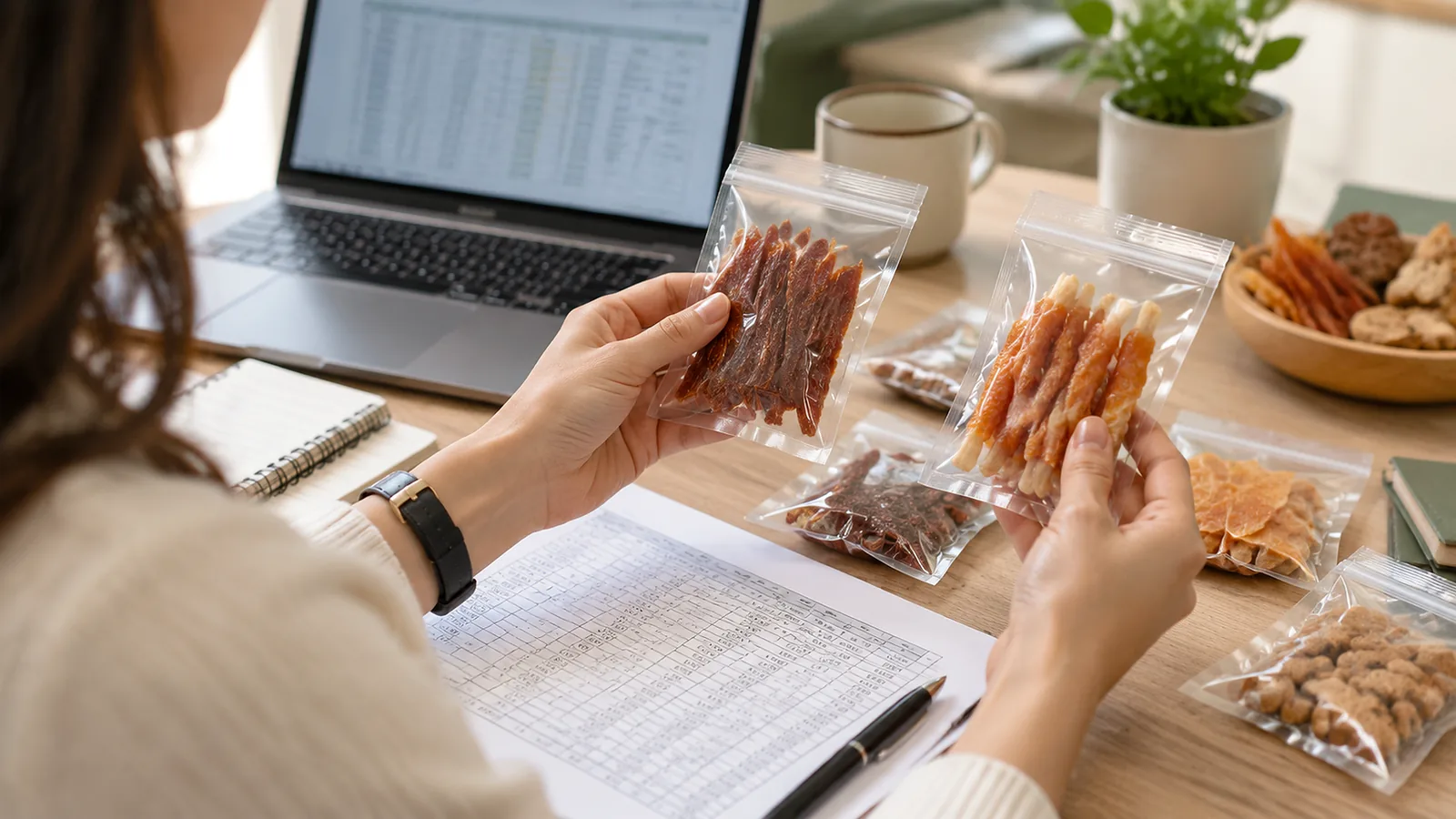
- Samples and testing. Sample and courier costs (ask your supplier; policies vary), plus any third-party lab reports you want per lot.
- Freight. At 1,500 kg, dried treats often ship as LCL (less than container load) rather than a full container. Get quotes for both FOB plus your own forwarder and for CIF.
- Destination costs. Customs brokerage, duties, port fees, any required permits or filings, and inland freight to your warehouse.
- Contingency. Set aside a buffer for freight swings, relabeling or rework, and sample rounds.
Divide the total by 15,000 pouches to get your landed cost per pouch, then check it against your target retail price and channel margins. If the math does not work, the usual levers are pack size, packaging type, meat share and the number of SKUs in the first order.
| Budget line | Main driver | Where to get the number |
|---|---|---|
| Product | Protein, meat share, format | Manufacturer quote per kg, per SKU |
| Packaging | Pack type, size, print run | Manufacturer or packaging converter |
| Samples and testing | Rounds of samples, third-party reports | Manufacturer and lab |
| Freight | Volume, LCL vs FCL, Incoterm | Freight forwarder or CIF quote |
| Duties and clearance | Tariff classification, origin | Customs broker, official tariff schedule |
| Compliance | Label review, registrations, permits | Regulatory consultant, authorities |
How to Lower Your First-Order Risk
- Start with one hero SKU. Put most of your first budget behind the product you are most confident in, and add SKUs once you have sell-through data.
- Use existing recipes. A proven recipe from the manufacturer’s library avoids development time and shelf-life uncertainty.
- Share one protein across SKUs. Building several SKUs on the same meat can simplify sourcing; ask your supplier whether it helps with minimums.
- Use a stock pouch with a label for a test run. Move to fully printed pouches once the product is proven.
- Consolidate shipments. Shipping several SKUs together, or with other products you import, spreads freight and brokerage cost.
- Stagger packaging. Ask whether part of a production lot can be held in bulk and packed later, and what that does to shelf life and cost.
Whether minimums can be combined across SKUs, and how samples are charged, depends on the specific recipes and packaging, so ask us for your case rather than assuming.
Timeline: Samples 2–3 Weeks, Production 30–45 Days
Cash is tied up from deposit to sell-through, so the timeline is part of the budget. At our plant, samples take 2–3 weeks, and production takes 30–45 days after artwork and the approved sample are confirmed. Add ocean transit, customs clearance and time for your own label review. Payment is typically by T/T or L/C; agree on deposit and balance terms before production starts.
For the full process from brief to shipment, see our private label dog treats guide. To see how we run OEM, ODM and private label projects, visit our OEM/ODM page, or browse ready-to-label recipes on the products page.
FAQ
What is the typical MOQ for private label dog treats?
Export-focused manufacturers usually quote MOQs per SKU by weight. At SAGEIC, the private label MOQ is typically from 500 kg per SKU and is negotiable depending on format and packaging.
Can I mix SKUs to reach the MOQ?
It depends on the recipes, protein and packaging involved. Ask us with your SKU list and we will tell you what is possible for your order.
Do samples cost money?
Sample and courier charges vary by project and destination. Send us your brief and we will confirm sample terms before anything is made.
How much does it cost to start a private label dog treat brand?
There is no single figure: it depends on the number of SKUs, protein, format, packaging, freight and duties in your market. Build your budget line by line using the structure above and get quotes for each line.
Is FOB or CIF better for a first order?
CIF is simpler if you do not have a freight forwarder. FOB gives you more control over freight cost and timing. Either way, destination charges and duties are paid on your side.
Get a line-item quote for your SKUs
Tell us your target market, formats, pack sizes and expected annual volume. We’ll send a quote broken down by product and packaging, with MOQ and timeline for each SKU. Email sales@sageicbiotech.com or WhatsApp +86 150 9208 3750.